
Let's discuss the finishing methods for blades: concave grinding, flat grinding, convex grinding, and Scandinavian grinding each have their advantages.
- HUEI HONG JHENG
- Feb 8
- 4 min read

When we talk about sharp blades, we think of sharpening.
After all, sharpening a blade is synonymous with making it sharp.
Sharpening makes the blade thin enough to achieve the ideal cutting edge.
Imagine a 4mm thick steel plate; if only the cutting edge is sharpened, while the rest remains unsharpened, its performance will be significantly reduced.
This is why blades need to be sharpened.
Generally, we say the thinner the blade, the better.
However, it must be mentioned that the thinner the blade, the more susceptible it is to damage.
A thinner blade is more prone to breakage.
A thinner cutting edge is more prone to chipping.
Therefore, if you want to sharpen your blade, it's best to understand the steel and intended use.
Just like a razor used for shaving can be very thin and work great, but if you use it for outdoor purposes, the razor will definitely be ruined.
Conversely, a thick survival knife is ideal for chopping wood, but absolutely unsuitable for peeling apples.
Therefore, we often infer a blade's intended use and its capabilities based on its thickness.

HOLLOW Grinding

HOLLOW grinding, also known as hollow grinding or center grinding, is a type of grinding where the blade is recessed downwards.
One advantage of HOLLOW grinding is that the blade is extremely thin, resulting in an exceptionally sharp edge.
This is why almost all razors use HOLLOW grinding.
The thin blade, making it sharp, is its advantage.
However, this thinness is also its disadvantage.
As mentioned earlier, a very thin blade is more fragile.
Therefore, it is more prone to damage.
So, the thickness of the HOLLOW blade and its performance depend on each manufacturer's core technology.
Thin blades are unsuitable for chopping and are naturally unsuitable for outdoor use, so they are rarely seen on large knives.
We can see that currently, concave grinds are primarily used on small folding knives or small-sized knives.

Flat Grind

Most knives we've encountered so far have a flat grind.
The grind extends from the cutting edge upwards to the back/ridge of the blade.
The flat grind can reach up to half the blade length, and sometimes even the back.
This finish, which we call flat grind, is used on almost all kitchen knives.
The advantages of a flat grind are that it's relatively easy to achieve, looks good, and is aesthetically pleasing and sturdy.
The disadvantage of a flat grind is that the back of the blade is slightly thicker.
Furthermore, compared to a concave grind, a flat grind is thicker; after all, in the face of extreme sharpness, usability and intended use must also be considered.
Convex Grind

Convex grinds often present a series of problems.
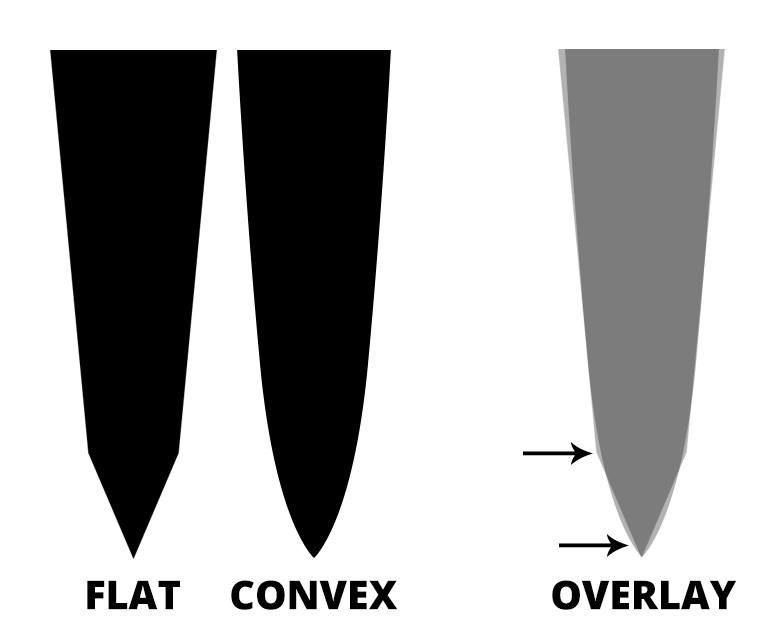
This type of grinding differs significantly from concave and flat grinding; it's circular.
Convex grinding offers many advantages, including a stronger blade and superior cutting performance.
The rounded angles of convex grinding make it more conducive to cutting.
As shown in the image.
You can see that when a convex and flat grinding blade are placed side-by-side, the flat grinding's angle is more prominent.
This is also a key difference between flat and convex grinding.
Furthermore, in the latter half of the blade, a convex grinding blade is noticeably thicker than a flat grinding blade.
This results in greater strength for the convex grinding blade.
Convex grinding is a perfect combination of high strength and excellent cutting performance.
You'll truly appreciate the advantages of convex grinding, especially when making feather sticks.
However, convex grinding also has disadvantages.
For example, producing excellent convex grinding blades in a factory is not easy; the manufacturing process is complex.
Secondly, knives with excellent convex grinding are more expensive because they require a significant amount of manual labor to complete.
In addition, some knife enthusiasts have found that convex-grind knives are not easy to sharpen themselves after receiving them.
SCANDI Sharpening

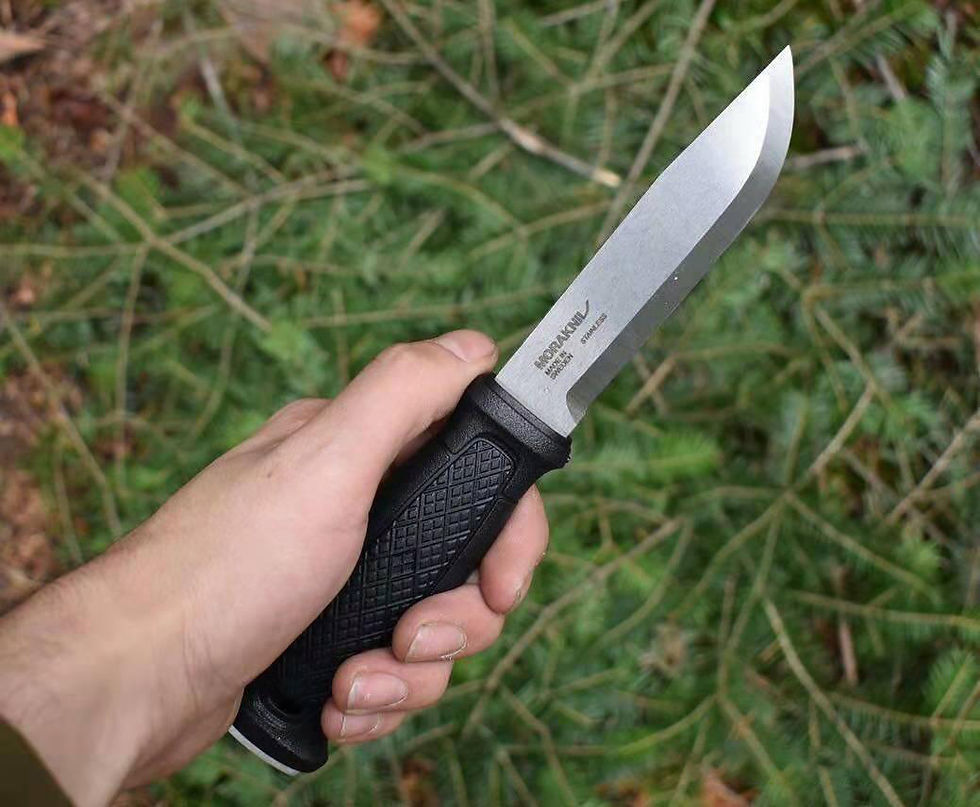
SCANDI sharpening has been a popular choice for outdoor knives, hunting knives, and jungle knives for many years.
The unsharpened portion of a Scandinavian-grind knife is very large, and there are no additional sharpening features.
The practicality of Scandinavian sharpening lies in its ease of sharpening; it's easy to get it sharp.
Furthermore, Scandinavian sharpening is ideal for working with wood because the blade is relatively thick and therefore very durable.
However, when sharpening a Scandinavian blade, care must be taken to avoid mistakes. If you make a mistake during sharpening, you may have to grind away a considerable amount of material to correct it.
For any knife, the following points should be considered:
Choose the appropriate type of steel for the appropriate task.
If you're doing a lot of work with your knife, you won't choose a thinner sharpening.
It's best to choose a harder steel and a suitable sharpening method.

There is no inherently better or worse sharpening method than another.
As mentioned in a previous post about knives, each grinding method has its greatest advantage for certain specific tasks.
A concave grind offers extreme sharpness, making it great for shaving.
A convex grind provides excellent durability and cutting ability, making it excellent for outdoor use.
A flat grind is aesthetically pleasing and durable, making it a favorite for kitchen knives.
A Scandinavian grind is durable and practical, excellent for working with wood.
The examples above are just a few examples of the tasks these grinds are suitable for.
These are just a few typical examples, not because they are only suitable for one type of task.
No one grind is better than another, only more suitable for a particular task.
No one grind is inherently superior; it's simply a matter of personal preference.
The knives on the market prove this point; different grinds are used in different categories of knives.
Finally, the grinding method does not indicate the quality of a knife; it only indicates the quality and performance of the grind itself.


Comments